

Navigating a Tough Ag Economy in 2026
Strong Production in 2025 Resulted in an Oversupply of Corn
One of the biggest wins from last season was corn production, with record or near-record numbers of the crop planted across the country.1 Product innovations, favorable weather patterns and effective management contributed to corn and soybean yields, and, from a macroeconomic standpoint, healthy commodity supply. But while production was strong, demand for some U.S. commodities waned, meaning many growers saw decreased profitability and ended 2025 with an oversupply.2
Because of this, the U.S. started the 2026 season with surplus corn inventories. That puts pressure across the market, nationally with commodity prices as well as business decisions at an individual farm level.
Another macro trend was rising costs, which could be felt in everything from inputs like fertilizer and crop protection to larger operating expenses such as machinery and rent. For years, we’ve seen business needs, including the cost to borrow and access to steady financing, strain farmers’ cash flow, and 2025 was no different. Even with these challenges, data suggests most growers maintained their investments in inputs, which we believe helped contribute to high yield numbers.
Uncertainty Around 2026 Market Conditions
Many economic variables remain in 2026 with the potential to shift markets. Initial federal farmer relief packages have some growers optimistic. In terms of commodity global supply and demand, we are watching closely whether China will fulfill its agreement to purchase U.S. commodities in 2026 and how commodities factor into any new trade deals that may form through 2026.
If interest rates continue to trend down in 2026, this could help benefit farmers’ businesses by putting less pressure on their balance sheets. Here, you can see a visual of how rates have varied in the last ten years. As of January 19, 2026, the Bank Prime Loan Rate was 6.75 while the Effective Federal Funds Rate sat at 3.64.2 While rates are trending down, they remain historically high, adding complexity to how growers choose to invest in their operations longer-term.
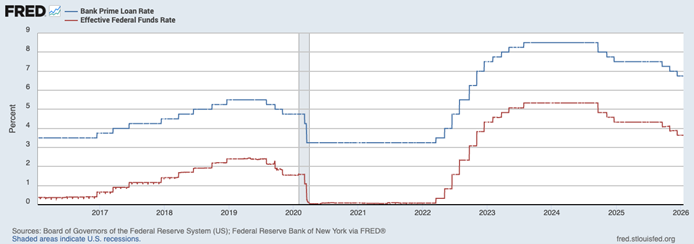
As of January 19, 2026. Sources: Board of Governors of the Federal Reserve System (US); Federal Reserve Bank of New York via FRED®. https://fred.stlouisfed.org/graph/?g=KacO#
WinField United continues to keep a close eye on market dynamics to shape our expectations for the rest of 2026.
Invest Your Dollars Where You Can Gain Greater Value
For growers looking to balance revenues and costs, we recommend shifting focus from up-front cost to ROI potential. Particularly for inputs, a grower’s investment decision should incorporate the value of the input — this could be protecting existing yield against threats or increasing a crop’s total yield potential. For example, a high-value seed treatment or effective fungicide may be an up-front cost that could help defend your crop from risk and potentially boost yields, therefore increasing revenues. Your local retailer can use their robust local data and tools to help you navigate ROI-based decisions and total-acre investment options.
How the Local Cooperative System Can Play to Your Advantage
Navigating tough budgets, finances and market dynamics can be challenging, but this is the kind of market in which cooperatives can really demonstrate their value to growers. Those working with their local co-ops and retailers are in a uniquely advantageous position to get the products they need from a partner who has regional agronomic expertise.
Our local retailers and co-ops are the heartbeat of their rural communities. As such, their employees are seen as trusted advisors to help you navigate not just a single variable or input decision, but holistically across the total acre, within a complex and dynamic macroeconomic environment. From fertilizer to seed, local retailers and co-ops have the options available to fit growers’ budgets, paired with local expertise to help maximize growers’ ROI potential for this year’s crop.
Find a Trusted Partner
The main takeaway is this: While the market will continue to change, the reliability of the cooperative system is a constant. Seize the opportunities available by working with your local retailer to take advantage of their expertise paired with our national support.
Find a retailer near you here or reach out to yours to get started planning for 2026.
1 Crop Production 2025 Summary (January 2026). United States Department of Agriculture (USDA) and National Agricultural Statistics Service (NASS). https://esmis.nal.usda.gov/sites/default/release-files/795725/cropan26.pdf
2 USDA Reports Record 17 Billion Bushels of Corn in 2025, Pressuring Prices and Farmer Incomes. Successful Farming, January 13, 2026, https://www.agriculture.com/partners-usda-says-2025-corn-production-hit-17-billion-bushels-likely-to-keep-prices-low-11884347.
3 Federal Reserve Bank of New York, Effective Federal Funds Rate [EFFR], retrieved from FRED, Federal Reserve Bank of St. Louis; https://fred.stlouisfed.org/series/EFFR, accessed January 19, 2026.
All photos are either the property of WinField United or used with permission.
© 2026 WinField United. Important: Before use always read and follow label instructions.Crop performance is dependent on several factors many of which are beyond the control of WinField United, including without limitation, soil type, pest pressures, agronomic practices and weather conditions. Growers are encouraged to consider data from multiple locations, over multiple years and to be mindful of how such agronomic conditions could impact results. Class Act, CornSorb, Dimetric, InterLock, NG, StrikeLock, SuperLock and WinField are trademarks of WinField United. All other trademarks are the property of their respective owners