
Make the Most of Your Fungicide Application
If I had a crystal ball, I could tell you how heavy disease pressure will be in the future. But since I don’t, my best advice is to use data and your trusted advisors to determine the best course of action to protect plant health.
Use resources to make educated fungicide decisions.
You already have access to data that can help you determine the ROI potential of a fungicide application. First, l recommend looking at your seed guide. Most companies rate hybrids and varieties for their tolerance to specific diseases. Seed choices with lower tolerance to diseases are good candidates for fungicide protection.
While the seed guide is a good place to start, Answer Plot® data provides even more helpful information. Each year, we test more than 240 hybrids across seed brands to determine response-to fungicide (RTF) scores. Unlike most seed guides, which base disease ratings on visual observations, actual yield results from Answer Plot trials are used to calculate the potential yield response of a fungicide application by hybrid. The trials are replicated multiple times at each of the Answer Plot locations across the U.S. to account for different growing conditions and geographies. 2025 data shows fungicide yield response ranges from 0.2 to 38 bu/A,1 reinforcing how differently hybrids can respond.
Scout fields diligently to determine optimal application timing.
Once you understand where you’re likely to see the best response to fungicide, it’s time to survey fields. Scout early and often, especially if environmental conditions favor disease development. In general, you’ll see the best ROI when applying a fungicide at tassel time. But if disease starts early and is progressing quickly, a V5 application can help protect plants until tasseling.
Get the most value from your fungicide application by adding adjuvants and micronutrients to the tank mix. Effective crop protection depends on good coverage because it’s not about the ounces of product per acre you spray — what’s important is that the active ingredient is actually reaching the plant.
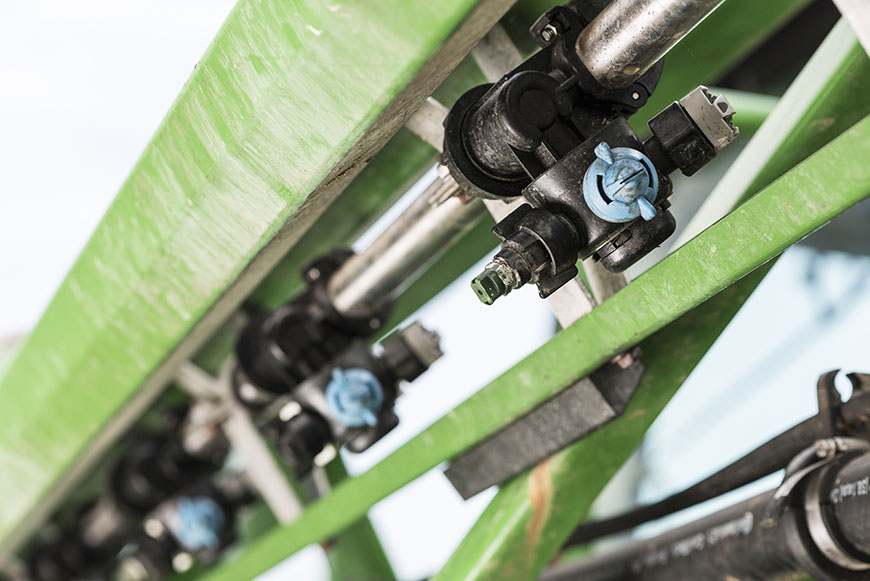
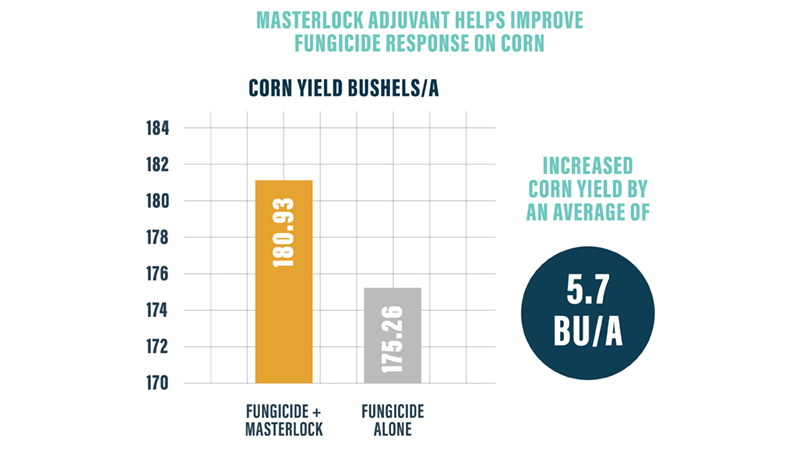
MasterLock® adjuvant optimizes droplet size to reduce drift potential and help ensure more product penetrates into the canopy. It also contains a surfactant to help cover more leaf surface area, leading to an average yield increase of 5.7 bu/A in corn2 and 3.7 bu/A in wheat3, compared to fungicide alone.
To target deficiencies and boost plant health, add MAX-IN® Ultra ZMB® micronutrient or MAX-IN Boron micronutrient to your application plan. Both of these micronutrients can be mixed with other plant nutrients and crop protection products, making your application more effective.
Adding a biostimulant such as YieldOn® is an efficient way to mitigate in-season stresses that could challenge your crop by applying it at the same time as fungicide. YieldOn increases crop productivity and supports the transport of key nutrients throughout the plant for higher potential fungicide ROI.
Want to know more about maximizing the impact potential of your fungicide application? Watch the video below for tips from a WinField United agronomist, or contact your local retailer.
Your local WinField United retailer can recommend the right fungicide and partner products based on your hybrids and field conditions. Speak with them today to learn more about RTF scores and best practices for fungicide applications.
1Internal Answer Plot studies. Difference between fungicide at R1 and untreated control.
2WinField United. 14 studies, eight states, all fungicides. 2012–2017.
3WinField United. 12 trials, five locations across the U.S. and Canada. 2019-2021.
*Agreement is required, and conditions, restrictions and service fees apply. Percentage goals for the Approved Yield range from 95–105% for corn and 95–100% for soybean. Due to factors outside of WinField United’s control, results to be obtained cannot be predicted or guaranteed by WinField United. Results may vary.
All photos are either the property of WinField United or used with permission.
© 2026 WinField United. Important: Before use always read and follow label instructions. Crop performance is dependent on several factors many of which are beyond the control of WinField United, including without limitation, soil type, pest pressures, agronomic practices and weather conditions. Growers are encouraged to consider data from multiple locations, over multiple years and to be mindful of how such agronomic conditions could impact results. Answer Plot, MasterLock, MAX-IN, WinField and ZMB are trademarks of WinField United. All other trademarks are the property of their respective owners.

Related Articles